
In my last couple of posts, Shadow Work: What Is It? Because It's Not What Instagram Told You and Shadow Work in Mysticism and Mythology: Why Spiritual Transformation Begins in Darkness, I discussed what shadow work is, its origins, and how it is intertwined with spirituality and mysticism. In this post, we're going to look further into the spiritual side of shadow work. It's more than just healing trauma or identifying triggers. It's about reclaiming the fragmented parts of our soul, deepening intuition and authenticity, and, with any luck, experiencing an awakening.
As stated in previous posts, shadow work is less about "fixing ourselves" and more about becoming whole by integrating those shadow aspects of ourselves. I love spirituality, working with and healing energy that is blocked or stagnant, becoming aware of patterns and cycles, and working with the universe to find guidance. However, there is a danger in spirituality: toxic positivity, which often emphasizes love and light while avoiding grief, anger, shame, fear, and rage.
I am not saying that someone who does light work automatically falls into toxic positivity. Oftentimes, that type of positivity comes from ignorance. I have several good friends who radiate positive energy. It oozes from them like light from the sun, but they are also doing the work to process their shadow selves.
What Makes Shadow Work Spiritual?
Okay, we know that Jung talks about the psychology of shadow work, but what makes it spiritual?
Shadow work becomes spiritual when it is used for self-awareness, energetic healing, soul integration, and spiritual awakening. Sounds very mysterious, right? It can be difficult to wrap your head around at times. Becoming self-aware is one thing, but it can't stop there. Simply acknowledging emotions is great, but those emotions can manifest in other ways, such as spiritual bypassing, "love and light" personas, and projection onto others.
The purpose of shadow work is about more than just acknowledging our darker emotions and patterns. It's about learning how the traits we reject in ourselves often hold hidden gifts. Debbie Ford, whom I discussed in my previous post, gives examples such as suppressed anger hiding healthy boundaries or jealousy revealing neglected desires.
Ask yourself: What parts of myself do I try hardest to hide?
The Mirror Technique
Now that we understand what shadow work is and how it can become spiritual, what techniques can we put into practice actually to do the work?
The first technique I would like to introduce is the Mirror Technique. This is one of the fastest ways to identify shadow material. It involves taking a look at how you react emotionally to others. If someone intensely irritates, fascinates, or unsettles you, they may be reflecting something unresolved within yourself.
At this point, you're probably wondering, "Okay, that's great, but how do I do this?" To practice the Mirror Technique, identify your strong emotional triggers. Ask yourself:
What specifically bothers me?
Where does this trait exist in me?
What am I afraid this says about me?
Then explore whether this trait has a hidden strength or gift, as Ford suggests in The Dark Side of the Light Chasers.
Chances are you've projected onto someone at some point in your life, and someone has likely projected onto you as well. Negative traits aren't the only things that can be projected—positive traits can be, too. If we idealize someone's confidence, creativity, or intuition, it's likely a reflection of a trait that lies dormant within ourselves.
Likewise, if we project negative traits onto someone by saying, "That person is so obnoxious," it may be something we dislike within ourselves. Pay attention when you begin to judge someone or when someone has a strong negative reaction to you. Reflect on those moments. Sometimes difficult people can become our most unexpected teachers.
Ford mentions that we often give away our power by projecting traits onto others instead of reclaiming them ourselves.
Shadow Journaling
Shadow journaling is something I have discussed briefly in my previous posts. The shadow thrives in secrecy and suppression. Journaling creates a safe place for honesty without judgment. This has been one of my favorite ways to do shadow work. It's low-effort to start and gets you thinking about the hard questions you need to ask on your journey.
Questions like:
What emotion am I most uncomfortable expressing?
What am I secretly resentful about?
These prompts get you thinking and may feel uncomfortable at times, but that's how you know you're doing shadow work. If you're anything like me, you've probably tried journaling before. You stay consistent for a few days or maybe even a week or two, then you stop, and it becomes just one more thing you have to do.
Something that helped me was creating a ritual around it.
I wake up in the morning, take care of the pups, and make my coffee. While I'm waiting for the coffee to brew, I get out my journal and light a candle or some incense. Then I sit down with my dogs and enjoy my coffee while I write. The ritual doesn't need to be complicated or elaborate—just something simple and comforting.
I often end up writing intuitively during this little morning ritual as well. You can also meditate before writing or even pull tarot cards before or after journaling. Journaling is a great way to reveal what may have been buried for years: grief we haven't processed, rage from old wounds or trauma, or shame that we haven't acknowledged.
I would like to mention that journaling doesn't need to be done daily. That's simply what I choose to do. It can be done as often as you like. To get started right away, I have created a downloadable PDF Shadow Work Journal with 182 prompts here.
Meditation and Meeting the Shadow
If journaling isn't your thing, or the Mirror Technique doesn't feel like the right fit, there is always the tried-and-true method of meditation. For some, meditation is incredibly difficult. For me, it's one of the few times I can actually quiet my brain.
Meditation in shadow work involves sitting with the parts of ourselves we avoid. Instead of suppressing uncomfortable emotions, meditation allows us to witness them compassionately.
One of my personal favorite meditation techniques is visualization.
You're probably wondering what this looks like. Pick a shadow aspect of yourself that you want to confront. Where are you meeting them? In a forest? The dark ocean? A room full of mirrors? The castle Ford mentions in The Dark Side of the Light Chasers?
During your visualization, ask yourself:
What does this version of me look like?
What do they want to say?
What pain are they carrying?
The shadow often appears symbolically, which is why dreams, tarot, mythology, and meditation can all become shadow work tools.
This brings me to shadow archetypes.
As I have said in previous posts, the unconscious communicates through symbols, and archetypes are among those symbols. I'm not going to do a deep dive into them in this post, but perhaps I will in the future.
Archetypes are universal characters that embody aspects of our psyche. Chances are you've heard of these before.
Some of the most common shadow archetypes include:
The Exile — Represents rejected, hidden, or abandoned parts of ourselves.
The Warrior — Embodies strength and the will to fight for what matters. When buried in the shadow, this energy can manifest as suppressed anger or people-pleasing.
The Witch — A personal favorite of mine. This archetype represents intuition, mystery, personal power, and hidden knowledge. In the shadow, it may appear as a fear of being judged or standing out.
The Trickster — Disrupts illusions and exposes uncomfortable truths.
The Destroyer — A seriously misunderstood archetype. It often appears when something—such as a limiting belief or old identity—has outlived its purpose.
These archetypes aren't inherently good or bad. They are simply symbolic expressions of aspects of ourselves seeking recognition and integration.
Tarot as a Shadow Work Tool: Using Divination for Self-Confrontation
Tarot is seriously misunderstood and, in my opinion, a vastly underused tool for growth and guidance. It is typically depicted as a fortune-telling tool used to predict the future. While it can sometimes give insight into possible outcomes, tarot is really a tool for guidance and reflection. Tarot reflects our energy. It can help us communicate with our spirit guides, ancestors, higher selves, and yes, even our shadow selves. Tarot can be used as a tool to bypass our intellectual defenses and reveal subconscious patterns and emotional truths. I want to make it VERY clear: shadow work through tarot is NOT fortune-telling. It's self-revelation.
You're probably wondering, "What kind of spreads should I do?" You're in luck because I have a few suggestions.
The first is a "What Am I Avoiding?" spread. This spread reveals what you may be suppressing, why you're suppressing it, how it's affecting you, and what integration might look like.
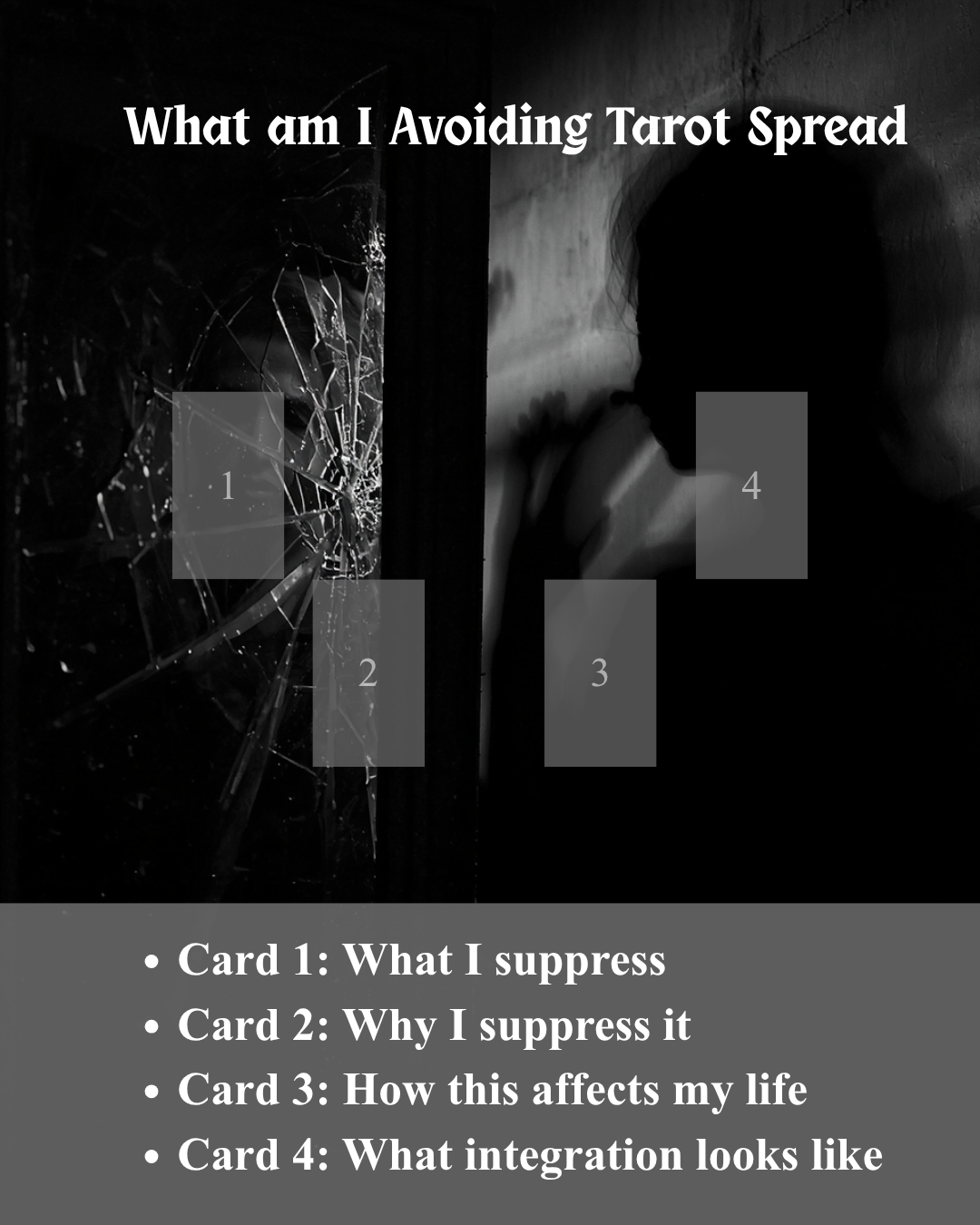
Terms of Use: You CAN use these tarot spreads to read for clients with (in paid readings) but the tarot spreads themselves may not be sold. Credit must be given when used.
Another spread is "The Hidden Self." This spread reveals what parts of yourself need acknowledgment, what lesson that part carries, and how you can work with it rather than suppress it, much like Ford discusses in her book. (Check out my previous post, Shadow Work in Mysticism and Mythology, for more.)
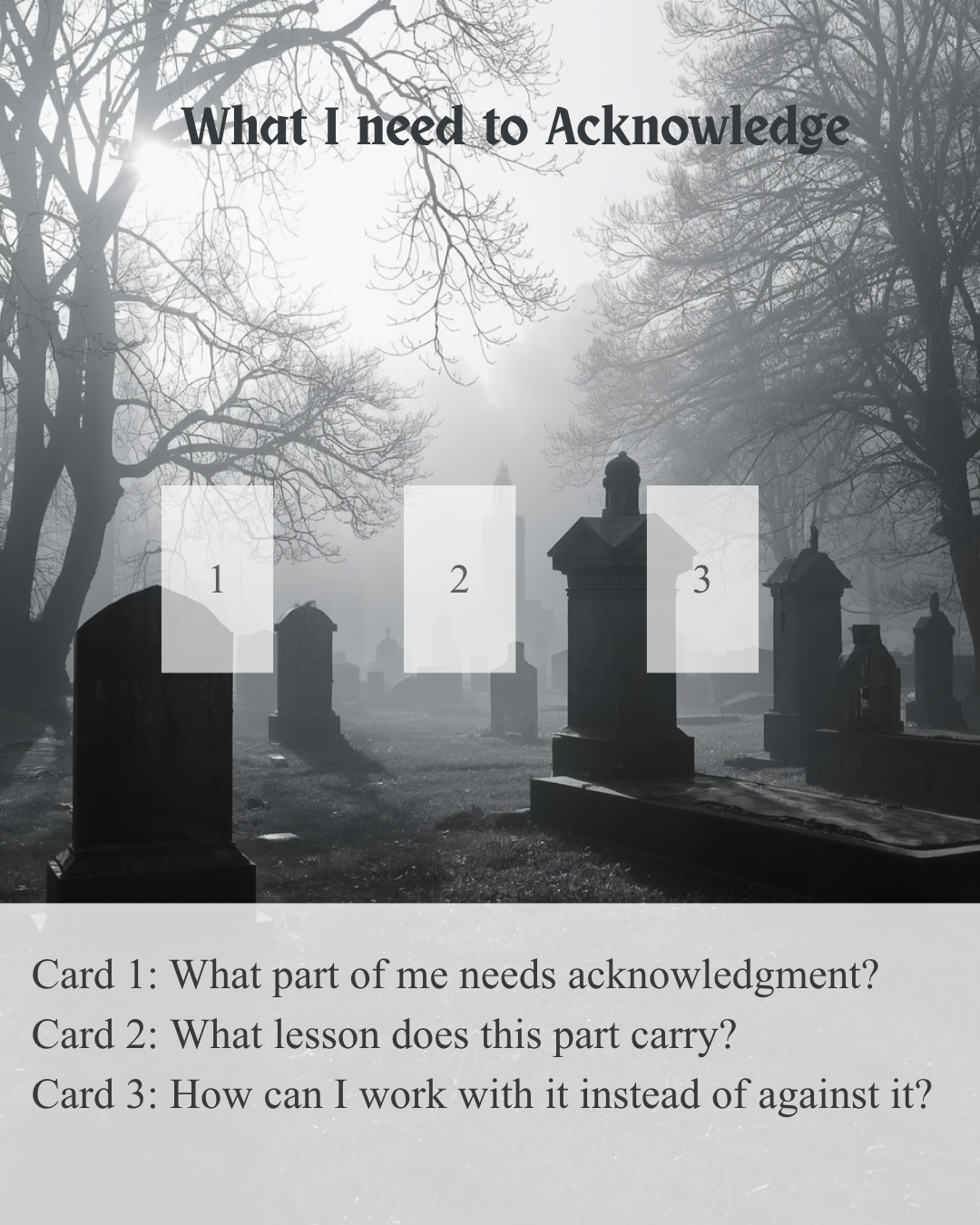
Terms of use: You CAN use these tarot spreads to read for clients with (in paid readings) but the tarot spreads themselves may not be sold. Credit must be given when used.
Note: These spreads can be added to as needed for more details.
The Dark Night of the Soul: When Shadow Work Becomes Transformation
If you listen to tarot readers online, chances are you've heard the term Dark Night of the Soul. But what does it actually mean? Originally, the term was used by a 16th-century monk named John of the Cross. One of his writings, Dark Night of the Soul, describes his experience of spiritual transformation while imprisoned. I discuss this concept in more detail in my previous post.
The term refers to a period of profound transformation, typically one that is uncomfortable. Sometimes shadow work initiates a collapse of identity. The person we thought we were no longer resonates or serves us. This can cause a complete identity shift, and that can be extremely uncomfortable. It can dismantle old beliefs, relationships, or spiritual frameworks, making it feel as though the things we once used to define ourselves no longer fit. When our identity shifts, it can lead to emotional numbness, isolation, loss of certainty, and grief.
I know what you're thinking: "Why would anyone want to do that?" While shadow work can be painful, it can also be enlightening. I cannot stress enough how important it is for shadow work to be grounded and intentional. Make sure you have a good support system. Go to therapy if needed. Rest when necessary. This is a long process, not something you will complete in a month or even a year. When we experience the Dark Night, illusions are stripped away, and what remains is often more authentic than the identity that came before.
Integration: Becoming Whole
I've said it in every post about shadow work so far: the goal of shadow work is NOT to become perfect. It's not about becoming endlessly positive or spiritually "pure." It's about integration. When we can weave the shadow aspects of ourselves together with the rest of who we are, we become whole. Wholeness comes from acknowledging the full spectrum of human emotion. Integrating these shadow aspects can increase creativity, intuition, and authenticity.
To finish up, I'll leave you with a few reflective questions:
What part of yourself deserves compassion instead of exile?
What would happen if you stopped fighting your own humanity?
Who would you become if you embraced your shadow instead of fearing it?
Shadow work is sacred because it asks us to face ourselves honestly. This path is not only about ascension into a lighter version of ourselves, but also a descent into truth. True healing comes when we stop dividing ourselves into "good" and "bad." The shadow is not the enemy of the soul.
Sometimes it is the doorway.
Sources
Rebecca Rosen. Why Shadow Work Is Essential for Spiritual Awakening. January 30, 2025.
Rebecca Rosen BlogThe Holistic Counseling Center. The Spiritual Side of Shadow Work.
The Holistic Counseling Center ArticleThe Dark Side of the Light Chasers by Debbie Ford.
Further Reading
Meeting the Shadow edited by Connie Zweig and Jeremiah Abrams
Women Who Run With the Wolves by Clarissa Pinkola Estés
Tarot for Your Self by Mary K. Greer