Tarot and Self-Reflection — What My Beginning Tarot Journey Has Taught Me
Using the Cards and Journaling for Personal Growth
Starting My Tarot Journey
My interest in tarot and all things metaphysical has always been around, ever since I saw Hocus Pocus for the first time, but what really cemented it was my crazy aunt, who brought a pendulum and oracle cards to a family vacation. I was mesmerized by the crystal hanging from a chain that moved all on its own whenever you asked it a question. I tried to logic it away as best I could, but when I tried it myself, I was convinced.
From there, I began expanding my knowledge of other divination, metaphysical, and spiritual practices. While I had known about tarot for a long time, I always thought you had to be psychic to use it. As I got older, I continued to explore tarot and other divination tools, as well as witchcraft, but that is a story for another time. I would dabble off and on with tarot over the years until, finally, five years ago, I got serious.
Tarot helped me learn about myself and guide me. Then I started reading for my family, then for friends, and finally, here we are. Now I am looking to share that guidance with the world around me.
Now, I had the same misconceptions many beginner readers have. I thought tarot was meant to help me see the future and tell me what my future was, using it as a fortune-telling tool. That is what I expected from tarot: for it to tell me my future. As I grew in my practice, I began to find a better use for it as a tool for guidance and reading energy.
For me, this is what tarot really is. It’s more than a divination tool, and while I do think tarot can help us see potential outcomes, the future is never certain. It can also be used as a tool for self-reflection, especially when paired with journaling.
Whether you’re reading for yourself, learning tarot for the first time, or receiving a reading from someone else, tarot can create opportunities for deeper self-awareness and personal growth.
What Makes Tarot a Tool for Reflection?
As discussed in other posts, reading tarot involves symbolism and the interpretation of those symbols. In Seventy-Eight Degrees of Wisdom by Rachel Pollack, she emphasizes that tarot is not just a collection of fixed definitions to memorize. Instead, she presents it as a symbolic language that reflects universal human experiences.
Pollack and Jung’s work have a nice overlap in their discussions of archetypes: the recurring characters, situations, and themes that humans recognize. One of my favorite cards, the Death card, is often taken as bad in a reading. In reality, it is more symbolic of transformation and endings that make way for new beginnings. Pollack argues that archetypes like this and others resonate because they reflect experiences that nearly everyone encounters at some point in life.
To better explain this, let’s take a look at another Major Arcana card, The Fool. For posterity, I will be referring to the traditional Rider-Waite artwork. The symbolism here is interpreted in many different ways by many readers.
The cliff is seemingly a dead end, like there is nowhere else to go. The Fool is also the first card in the Major Arcana. He’s the first step into what is called “The Fool’s Journey,” but that is a whole article on its own.
The Fool asks us to take the first step, a leap of faith. It can be the green light for starting something new. The person depicted in the art is a young man with a “hobo” pack and a spring in his step, much like someone who is excited about a new chapter and has yet to come up against a challenge. There is much excitement and hope in the energy of this card. The flower that he is holding is another symbol of new beginnings.
With a basic understanding of the card’s meaning, we can begin creating our own interpretations as we advance in our practice. Learning the meanings of the cards through the traditional artwork and symbols has helped me better translate other decks that are not traditional.
As I began to grow in my practice, I started working with more symbols in the cards and even began to learn the elements, signs, and numerology associated with them.
There are some cards that I still struggle to interpret, and sometimes the entire suit of Swords still gives me some difficulty. I really think that is because I draw a lot of Swords for myself, and if you read the guidebook, sometimes the Swords can feel a little… cold.
Tarot doesn’t provide us with absolute answers; rather, it invites us to ask questions. It's also important to note that when we look at the symbols, we should trust our intuition. What jumps out at you first when you see a card? What feeling did you get when you looked at it?
The Power of Symbols in Self-Discovery
Have you ever looked at something or smelled a familiar scent and suddenly your mind is taking a trip down memory lane? This is your brain recognizing symbols and associations.
Symbols can help us connect to emotions and thoughts that may be difficult to articulate directly. One smell that I love—and this may sound odd—is a specific combination of cigarette smoke and cologne. It always reminds me of my uncle, who was a very unique guy whom I affectionately called “Uncle Monkey.” It fit him well; he was always joking and pranking.
Other symbols, like rainbows, make me think of my grandmother, whom I think about often. I know that she is one of my guides in this life.
Much like Pollack, Jung explores symbols, though he didn’t directly connect his study of symbolism with tarot. Some basic examples of symbolism within tarot include:
The Hermit: introspection
The Tower: change
The Star: hope
These are, of course, the most basic meanings. Different people will have slightly different meanings for the same cards. The meaning often comes from the conversation between the symbol and the individual.
Why Journaling Enhances Tarot Practice
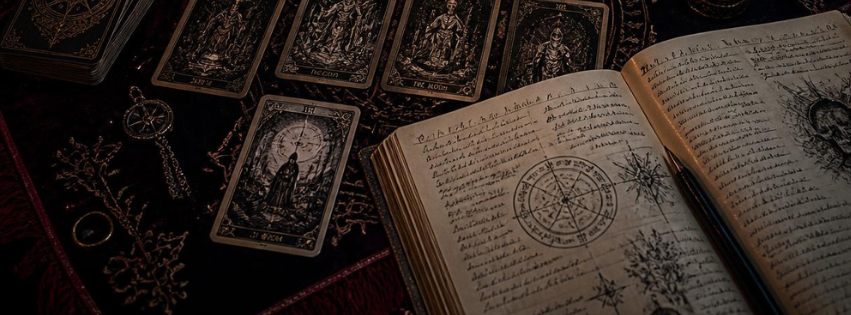
In Mary K. Greer’s book Tarot for Yourself, she discusses how tarot can be used as a tool for self-discovery. Oftentimes, when new readers begin tarot, they start with a tarot journal. This is helpful for reflecting on readings and creating your own interpretations of the cards, as well as memorizing their meanings.
Writing our readings down also gives us a place to go back and reflect. This gives us a record of our growth over time.
Some prompts to start with:
What stands out most in this card?
What emotions arise when I look at it?
How does this connect to my current situation?
What lesson or perspective might this card be offering?
I’ve discussed journaling in many of my previous posts, and I know by now I may be becoming redundant. Writing things down, for me, is a way to really solidify my thoughts and put focus behind them.
My tarot journal has been a great way for me to see my growth as a reader and better integrate what the cards are telling me into my life.
In a recent reading I did, I was asking for a message about what may be blocking my manifestations from fully coming through. As I was writing down the message, I realized I needed ways to actually put into practice what I was being told.
Tarot as an Ongoing Reflective Practice
Another good read I’d like to highlight is The Reflective Practitioner by Donald Schön. I don’t want to mislead anyone here: this book is not about tarot. In fact, it is about how professionals learn and think. However, the content is still applicable to tarot. In his book, Schön distinguishes between two different “modes” of reflection: the first is reflection-in-action, and the second is reflection-on-action.
Reflection-in-action is essentially thinking and adjusting while you’re doing something. In tarot, this can happen while you’re actively reading. It happens to me all the time. I typically interpret it not as “I read it wrong the first time,” but as both interpretations being right, or there being a second message that needs to be heard.
Sometimes, when we pull a card, the traditional meaning fits well with what we are feeling. Other times it doesn’t, and sometimes a second card changes the meaning of the first. If you’re resisting the traditional meaning or your first reaction to seeing a card, pay attention. That may be your intuition telling you something. That is reflection happening inside the experience.
Reflection-on-action is looking back afterward and considering what happened, what you noticed, and what you’ve learned. This is where a tarot journal can be especially helpful. Sometimes the most valuable part of a reading happens after the cards are put away. When I journal, it gives me the opportunity to sit down with my initial reaction, question my interpretation, and then return to it later with a different perspective. I do this often with the readings I post on social media as well.
When reading for yourself, sometimes you will pull a card that makes no sense, then days or months later it might. Not necessarily because it “predicted” anything, but because you now have more context. A tarot journal lets you see that evolution.
Reflection Is Valuable at Every Experience Level
As we begin our tarot journey, it’s easy to get caught up in the “Did I read that right?” mentality. An easy way to shift that is with a reflective question: “What is this card making me think about?”
An example of this would be when a beginner sees a card like The Hermit and their first reaction is to reach for the guidebook. There is nothing wrong with that. I have done that plenty of times myself. They will likely read something like solitude, introspection, wisdom, and inner guidance.
As you gain experience, you will begin to develop years of personal associations with the card. The next thing you know, The Hermit is making you ask, “Have I been isolating myself lately? Why?”
Both the beginner and the experienced reader came to reflection through different paths. While expertise can change how you interact with tarot, being a beginner doesn’t mean you can’t use tarot for self-reflection.
Conclusion
When I began my tarot journey, it was to seek answers about the future, to try to see what my “fate” was. As I began to explore the practice more, I learned the card meanings, symbols, different spreads, and how to be an interpreter for a language that is foreign to many, but I was still attempting to “see the future.” Then, over time, I began to understand what makes a meaningful reading.
I began to shift the way I worked with my cards from finding answers to asking questions. Tarot doesn’t always give clear answers or tell us exactly what we need to do next. Sometimes a reading leaves us with more questions than we started with, and our reaction to a reading is another thing worth exploring. That’s when the questions begin to change from “What is this card telling me?” to “Why am I reacting to this card this way?” or “What patterns keep appearing?”
These questions create a spark for initial reflection, and yes, the use of journaling gives us a place to put that reflection. Writing slows down the process enough to explore our thoughts rather than simply moving on to another card. On the flip side of that, returning to old readings lets us see how our interpretations—and we ourselves—have changed. The tarot journal becomes more than a record of readings; it becomes a record of personal growth.
As you grow in your practice, you will likely notice that the way you interpret the cards changes. That is because the person interpreting the cards has changed, even if the imagery has stayed the same. Our experiences change how we see the world, and even how we see imagery. That is part of what makes tarot such an enduring reflective practice.
And if you walk away from this article with nothing else, just take this:
The most meaningful part of tarot isn’t about finding answers about the future. It’s about learning to ask better questions about the present.